


AI-Driven Quality Improvement for Colonoscopy Surveillance: 97.5% Recall Resolution in Adenoma Patients Across 1.2 Million Procedures

DDW 2026 Research Summary · Latica & Gastro Health

Presented at DDW 2026 (Digestive Disease Week) · Community Gastroenterology Practice Group, Multi-State (Gastro Health) · AI Partner: Latica

1.2M Colonoscopy procedures analyzed
97.5% Recall resolution in adenoma patients (retrospective, up from 87%)
93.2% Of all procedures achieved a resolved recall plan
100% Scheduling completion for the 2,000 prioritized overdue high-risk adenoma patients (2025)

The Problem

Missing documented recall intervals create gaps in colorectal cancer screening and prevention. At Gastro Health, a multi-state community gastroenterology practice, more than 250,000 of 1.2 million procedures (22.3%) lacked a documented recall plan. Latica and Gastro Health evaluated whether a data informed intervention process could systematically close this gap and align recall intervals with clinical guidelines with particular focus on higher-risk adenoma patients.

The AI Intervention

Latica’s algorithm automatically extracted adenoma findings from pathology reports for risk stratification and identified patients appropriately excluded from recall by analyzing physician notes. Recall resolution was defined as a documented recall date, a verified recall exclusion, or a future scheduled recall. The program, initiated in May 2024, combined two distinct patient populations. One analyzed retrospectively and one monitored prospectively:

Retrospective Cohort

802,446 historical procedures · 2017–2023

Historical procedures were reviewed using AI-prioritized lists stratified by adenoma burden and time-since-colonoscopy. Patient records were updated with guideline-based recall plans, and overdue patients were contacted and scheduled.

Prospective Cohort

393,406 new procedures · January 2024–present

Continuous AI monitoring of new procedures, with reports generated approximately one month post-procedure to surface cases requiring recall entry — preventing new documentation gaps from forming going forward.

Results

Retrospective Remediation (2017–2023 procedures)

MetricBeforeAfterChange
Overall cohort recall resolution77.7%94%+16.3% (p<0.001)
Adenoma subgroup (272,597 higher-risk patients)87%97.5%+10.5% (p<0.001)

The retrospective intervention resolved recall plans for 131,000 additional patients. Of the higher-risk overdue adenoma cohort, 3,000 prioritized patients achieved 100% scheduling completion in 2025, with intervention continuing for additional overdue patients.

Prospective Monitoring (Jan 2024–present procedures)

Continuous AI monitoring maintained a 91.5% recall resolution rate across new procedures overall, and 96.1% among new adenoma patients demonstrating that prospective surveillance sustains high resolution rates without requiring retrospective cleanup.

Combined Impact Across ~1.2 Million Colonoscopies

1,113,152 colonoscopies (93.2%) achieved a resolved recall plan across both cohorts combined. The remaining 6.8% (81,700 procedures) are still under ongoing intervention.

Why It Matters

This is, to Latica and Gastro Health’s knowledge, the first AI-enabled, EMR-integrated program to apply both systematic retrospective remediation and prospective monitoring across more than 1 million colonoscopies to improve recall documentation and scheduling. The result: near-complete recall resolution for adenoma patients and timely scheduling pathways for high-risk individuals in a real-world community practice setting. Large language models, now being implemented, will further enhance adenoma risk stratification and advance precision care navigation in community gastroenterology.

Frequently Asked Questions

What is the difference between the retrospective and prospective patient groups in this study?

The retrospective cohort was 802,446 historical procedures (2017–2023) reviewed after the fact to remediate missing recall plans. The prospective cohort was 393,406 new procedures (Jan 2024–present) continuously monitored by AI in near-real time to prevent gaps before they occur.

What recall resolution rate did the AI intervention achieve in adenoma patients?

97.5% in the retrospective adenoma subgroup (up from 87%, p<0.001), and 96.1% among adenoma patients under ongoing prospective monitoring.

How many total colonoscopy procedures were included?

Approximately 1.2 million, combining the 802,446-procedure retrospective cohort and the 393,406-procedure prospective cohort. 93.2% (1,113,152 procedures) achieved a resolved recall plan.

Who conducted this research?

Latica., in partnership with Gastro Health (a multi-state community gastroenterology practice). Findings were presented at DDW 2026.

Source: “AI-Driven Quality Improvement for Colonoscopy Surveillance: Achieving 97.5% Recall Resolution in Adenoma Patients Across 1.2 Million Procedures.” Presented at Digestive Disease Week (DDW) 2026. Latica.AI & GastroHealth.“At Forefront, every decision we make is guided by one goal: to elevate the experience of both our patients and our physicians.” said Betsy Wernli, President of Forefront Dermatology. “Partnering with Latica enables us to advance this mission even further – leveraging data to drive better insights, optimize care, and improve outcomes in conjunction with our physician-led, best-in-class clinical quality program Forefront IQ”
About Latica

Latica (formerly Lynx.MD) delivers a transformative healthcare data ecosystem that accelerates medical research through secure collaboration and advanced insights. Founded by a visionary team of healthcare and technology innovators, Latica’s best-in-class data network empowers providers, researchers, and life science organizations to unlock actionable insights from high-quality, high-impact structured and unstructured data. Committed to driving breakthroughs in healthcare innovation and care delivery, Latica’s network is improving outcomes and shaping the future of medicine.

Unlocking Dermatology Insights: Going Beyond Codes with Real-World Clinical Data

The dermatology space is experiencing a powerful convergence: innovative therapies are reshaping treatment, while real-world data is finally catching up to the complexity of these diseases. Truly understanding conditions like atopic dermatitis, psoriasis, vitiligo, hidradenitis suppurativa (HS), and alopecia areata requires more than structured claims and diagnosis codes.
What’s often missing from traditional data sources is clinical nuance – the real-world details captured in physician notes, pathology reports, and procedural histories. That’s where the next wave of insight is coming from.

What’s Inside the Clinical Record?

AI is transforming the way we extract meaning from unstructured health data. For dermatologic conditions, this means pulling forward:

  • Precise disease location (e.g., scalp, extremities, facial involvement)
  • Severity markers and % body surface area (BSA)
  • Documented symptoms such as itch, pain, or bleeding
  • Patterns of steroid use and tapering/cycling
  • Procedures and biopsies, linked directly to diagnosis or treatment escalation
  • Pathology findings tied to inflammation, cellular markers, or co-diagnoses

These elements – buried in clinical notes, dermatology consults, and pathology PDFs – enable a much richer understanding of patient phenotypes and care pathways.

Why It Matters for New Therapies

Highly effective biologics and JAK inhibitors have changed the game for moderate-to-severe dermatologic disease. But measuring their use and effectiveness in the real world requires context.

By analyzing clinical documentation alongside prescribing data, it’s now possible to identify not just who is receiving advanced therapies like:

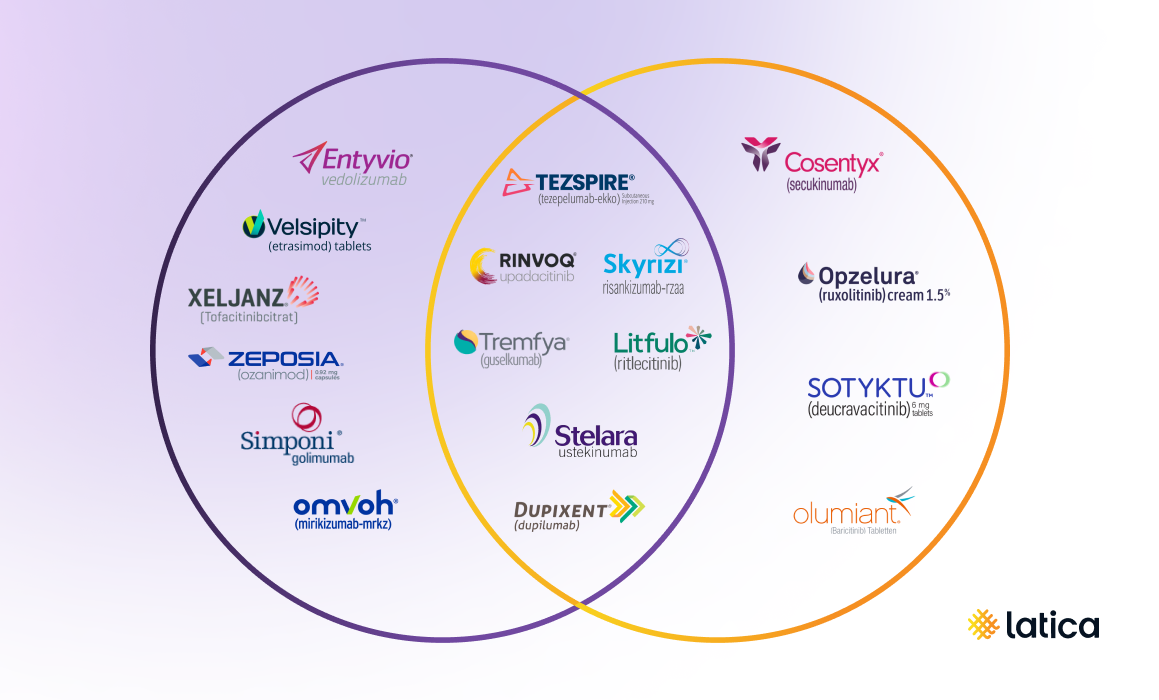
  • Tremfya, Skyrizi, Stelara
  • Rinvoq
  • Dupixent
  • Litfulo

…but also why they were chosen, when they were initiated (e.g., after topical/systemic failure), and how patients respond or cycle through alternatives.

This unlocks the ability to model real treatment journeys – capturing data on therapy escalation, discontinuation, combination regimens, and adherence patterns over time.

From Volumes to Value

Access to real-world patient volumes is critical – but even more valuable is the ability to segment these populations with clinical precision:

  • How many patients have head-and-neck involvement?
  • Who meets criteria for moderate-to-severe disease?
  • What proportion is cycling on and off steroids?
  • How many have undergone biopsies prior to biologic treatment?

These are the questions that drive decisions across clinical development, commercial strategy, and health economics. And they can now be answered with data.

About Latica

Latica (formerly Lynx.MD) delivers a transformative healthcare data ecosystem that accelerates medical research through secure collaboration and advanced insights. Founded by a visionary team of healthcare and technology innovators, Latica’s best-in-class data network empowers providers, researchers, and life science organizations to unlock actionable insights from high-quality, high-impact structured and unstructured data. Committed to driving breakthroughs in healthcare innovation and care delivery, Latica’s network is improving outcomes and shaping the future of medicine.

Exploring the Intersection of Inflammation & Immunology Diseases

Author: Collin Labar, Life Science Partnerships, Latica

Latica’s Data Network of Gastroenterology, ENT, and Dermatology connects at the center of one high impact market: Inflammation and Immunology.

Inflammation and Immunology (I&I) is at the heart of many chronic and debilitating diseases, spanning multiple healthcare verticals. These diseases are characterized by overactive or misdirected immune responses, leading to tissue damage, impaired function, and significant patient burden.

For life sciences companies, advancing I&I research is not just about innovation—it’s about transforming patient care through cutting-edge therapies powered by data-driven insights real-world evidence (RWE). At Latica, we enable this transformation by providing the tools and insights necessary to drive meaningful change in I&I research and patient outcomes.

The I&I Landscape: A Common Thread Across Verticals

From the gastrointestinal system to the skin and respiratory pathways, inflammation plays a pivotal role in disease progression. Conditions like Inflammatory Bowel Disease (IBD), psoriasis, and nasal polyps may manifest in different organs but are united by underlying immune dysregulation. This commonality has spurred the development of therapies that target shared inflammatory pathways, such as TNF-alpha inhibitors, JAK inhibitors, and interleukin (IL) modulators.

For instance:

  • TNF-alpha inhibitors like infliximab (Remicade) are effective in treating Crohn’s disease, psoriasis, and even certain ENT-related autoimmune conditions
  • IL-4 and IL-13 inhibitors such as dupilumab (Dupixent) have emerged as game-changers foratopic dermatitis, eosinophilic esophagitis, asthma, and nasal polyps, showcasing their versatility across dermatology, GI and ENT

This cross-vertical impact underscores the importance of comprehensive research and innovation that spans beyond disease silos.

The Role of Research and Real-World Data (RWD)

To truly transform care, life sciences companies need more than clinical trial data—they need insights from the real world. RWD, typically derived from electronic health records, claims data, patient registries, and even wearable devices, offers unparalleled opportunities to address critical gaps in I&I research.

How Latica Expands the Value of RWD:

  • Unstructured Clinical Data Access: Latica ingests all unstructured data from siloed data sources (physician notes, procedure reports, biomarkers, biopsies, precision medicine testing) and maps them to the patient journey, providing an in-depth understanding of clinical outcomes and patient phenotypes.
  • Comprehensive RWD Integration: By synthesizing structured and unstructured data, we provide a holistic view of patient journeys across verticals like GI, ENT, and dermatology.
  • Advanced Analytics: Our cutting-edge tools uncover trends, identify treatment gaps, and support biomarker discovery, paving the way for personalized medicine in I&I.
  • Accelerating Drug Development: From preclinical research to post-market surveillance, Latica enables life sciences companies to design better trials, predict outcomes, and validate therapeutic efficacy in real-world settings.
  • Supporting Value-Based Care: With our RWD-driven insights, organizations can demonstrate treatment value, improve payer-provider collaboration, and optimize patient care pathways.

Use Cases of RWD for I&I Advancements

Refining Patient Understanding

I&I diseases often present heterogeneously, with symptoms and severity varying widely. For example, some IBD patients may experience mild inflammation managed with oral therapies, while others require biologics to control severe disease. RWD provides a comprehensive view of disease phenotypes, helping researchers segment patient populations for better-targeted therapies.

Improving Treatment Pathways

Real-world evidence helps identify how therapies perform outside the controlled environment of clinical trials. This is particularly critical in I&I, where patient adherence, comorbidities, and long-term outcomes are key factors in treatment success. By analyzing RWD, life sciences companies can evaluate comparative effectiveness and fine-tune treatment pathways to improve outcomes.

Enabling Precision Medicine

Precision medicine relies on biomarkers to tailor therapies to individual patients. In I&I, this could mean identifying patients more likely to respond to IL-23 inhibitors for psoriasis or selecting JAK inhibitors for refractory cases of ulcerative colitis. RWD accelerates biomarker discovery and validation, ensuring therapies reach the right patients faster.

Supporting Post-Market Research

Therapies in the I&I space, such as biologics and advanced small molecules, are among the most innovative yet costly treatments available. Payers and providers demand robust, real-world evidence to justify these investments. Post-market studies using RWD not only demonstrate a therapy’s value but also uncover new indications and long-term safety profiles.

The Future of I&I Research with Latica

The intersection of I&I research and RWD offers a promising path forward for life sciences companies:

  • Shared Pathways, Shared Solutions: Cross-vertical therapies targeting inflammation offer scalable solutions for complex diseases.
  • Data-Driven Innovation: RWD enables life sciences companies to identify unmet needs, improve trial design, and validate outcomes.
  • Patient-Centric Care: Personalized therapies informed by real-world insights empower patients and clinicians to make better decisions.

The future of Inflammation & Immunology (I&I) research lies in breaking down data silos and leveraging real-world evidence to better understand disease heterogeneity, optimize treatment pathways, and advance precision medicine. By integrating structured and unstructured clinical data across specialties like GI, dermatology, and ENT, researchers can uncover shared inflammatory pathways, improve patient segmentation, and refine therapeutic strategies. Real-world data provides the missing link between clinical trials and everyday patient care, offering insights into long-term treatment effectiveness, biomarker validation, and post-market safety. As the field continues to evolve, harnessing these insights will be essential for developing targeted, data-driven solutions that improve outcomes for patients living with chronic inflammatory diseases.

About Latica

Latica (formerly Lynx.MD) delivers a transformative healthcare data ecosystem that accelerates medical research through secure collaboration and advanced insights. Founded by a visionary team of healthcare and technology innovators, Latica’s best-in-class data network empowers providers, researchers, and life science organizations to unlock actionable insights from high-quality, high-impact structured and unstructured data. Committed to driving breakthroughs in healthcare innovation and care delivery, Latica’s network is improving outcomes and shaping the future of medicine.